
Trees may appear silent and still, but they are constantly responding to information around them. Every day, a tree detects changes in sunlight, temperature, moisture, wind, soil conditions, nearby organisms, and even physical damage. Instead of using a nervous system like animals, trees rely on complex networks of chemical signals, electrical changes, hormones, and interactions with other living organisms.
Plant communication does not mean that trees talk in the human sense. Their signaling systems allow different parts of a plant to coordinate activities and help the tree respond to environmental challenges. Roots can react to changes in the soil, leaves can respond to insects, and chemical signals can travel through plant tissues to activate defenses. Understanding these processes gives scientists a better picture of how forests function as dynamic living systems.
What Does Plant Communication Mean?
Plant communication refers to the ways plants detect information and transmit signals within their own bodies or influence organisms around them. Because trees do not have brains, ears, eyes, or conventional nervous systems, their communication depends on biological mechanisms that operate at cellular and chemical levels. These systems help coordinate growth, defense, reproduction, and responses to environmental stress.
A tree constantly gathers information from its surroundings through specialized cells and tissues. Light-sensitive systems can detect changes in illumination, roots can sense water and mineral availability, and leaves can respond to temperature or physical damage. Once a change is detected, internal signals can trigger a response in another part of the plant, allowing the tree to adjust its behavior according to changing conditions.
How Do Trees Detect Their Environment?
Trees have sophisticated sensory mechanisms that allow them to detect environmental conditions even though they do not have traditional sensory organs. Receptors inside plant cells can respond to light, chemicals, temperature changes, mechanical pressure, and water availability. These signals can influence processes such as opening and closing leaf pores, directing root growth, or changing the production of defensive compounds.
For example, a tree growing in a shaded location may detect that it is receiving less light than surrounding vegetation. This information can influence the way its stems and leaves grow. Similarly, roots can detect areas of soil containing more water or nutrients and alter their growth patterns. These responses allow trees to make continuous biological adjustments without conscious decision-making.
Chemical Signals Inside Trees
Chemical signaling is one of the most important forms of communication used by plants. Trees produce hormones and other signaling molecules that can move from one tissue to another. These substances help coordinate activities such as growth, wound responses, water regulation, and defense against herbivores or disease.
One important plant hormone is jasmonate, which is involved in responses to physical damage and insect feeding. When a leaf is attacked, signaling pathways can activate defensive processes elsewhere in the plant. Other hormones, including abscisic acid, auxins, cytokinins, and ethylene, participate in different aspects of plant development and environmental response. Together, these chemical systems act as an internal communication network.
How Do Trees Respond to Insect Attacks?
When insects feed on a tree, the damage can trigger rapid biochemical changes. Cells around the damaged area detect the injury and activate signaling pathways. These pathways can cause the production of defensive chemicals, changes in gene activity, and alterations in tissues that make the plant less attractive or less suitable for the attacker.
Some trees can also release volatile organic compounds into the surrounding air after being attacked. These airborne chemicals may influence nearby plants by changing their defensive readiness. The exact effects vary among species and environmental conditions, but research has shown that plant-emitted chemicals can serve as important signals in ecological interactions.
Do Trees Communicate Through the Air?
Trees release many chemical compounds into the atmosphere, and some of these compounds can carry biological information. Volatile organic compounds are released from leaves, flowers, bark, and other tissues. Their production may increase when a plant experiences herbivore attacks, physical damage, drought, or other forms of stress.
Nearby plants can detect some airborne chemicals and alter their physiology in response. For example, exposure to certain plant volatiles may cause a neighboring plant to increase defensive compounds or change the activity of specific genes. This does not mean that trees are deliberately sending messages in the human sense. Rather, their chemical emissions become part of a shared environmental signaling system.
How Do Roots Communicate With the Soil?
The underground environment is extremely important for trees because roots are surrounded by microorganisms, fungi, minerals, water, and organic matter. Roots constantly interact with this environment by releasing chemical substances into the soil. These substances can influence microorganisms and may also affect the growth of nearby plants.
Root secretions include sugars, amino acids, organic acids, and many other compounds. They can help shape the microbial community around the roots and influence nutrient availability. In this way, a tree does not simply absorb resources from the soil; it also changes the biological environment surrounding its roots.
The Role of Mycorrhizal Fungi
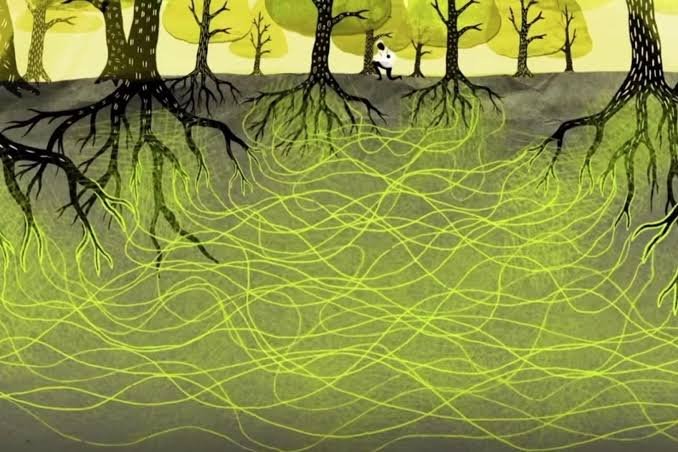
One of the most fascinating relationships involving tree roots is the partnership between trees and mycorrhizal fungi. These fungi associate closely with plant roots and can extend their fine filaments through the soil. The fungal network may explore areas that individual roots cannot reach easily, helping with the movement of water and nutrients.
In return, trees provide fungi with carbon compounds produced through photosynthesis. This relationship can become an important part of forest ecology. Researchers have also investigated whether fungal networks can facilitate the movement of chemical compounds and other resources between plants. However, popular descriptions of forests as having a simple underground communication internet can oversimplify a much more complicated biological system.
What Is the Underground Wood Wide Web?
The phrase “wood wide web” is commonly used to describe underground networks involving plant roots and mycorrhizal fungi. The expression became popular because fungal connections can link multiple plants within an ecosystem. These networks have attracted significant scientific interest because they may influence the movement of nutrients, carbon compounds, and chemical signals.
However, the reality is more complex than the phrase suggests. Not every tree is connected to every other tree, and the effects of fungal networks can vary depending on tree species, fungal species, soil conditions, and environmental circumstances. Scientists continue to study how much information or material moves through these connections and what ecological consequences those exchanges have.
Can Trees Send Signals Through Their Roots?
Roots can participate in chemical signaling within a plant and can interact with neighboring roots. When roots encounter changes in soil chemistry, nutrient availability, drought, or competition, they can modify their growth and release different compounds into the surrounding soil.
These root-mediated interactions may affect nearby plants and microorganisms. Some plants can release substances that discourage competitors, attract beneficial organisms, or influence microbial communities. Because roots operate in a crowded underground environment, chemical signaling provides an effective way for plants to interact without needing physical movement.
How Do Trees Communicate Internally?
A tree must coordinate its roots, stems, branches, and leaves. Internal communication allows distant tissues to respond when one part of the plant experiences stress. Signals can move through vascular tissues, including the xylem and phloem, while electrical and chemical changes can travel through plant cells.
For example, water shortage in the roots can lead to increased production of abscisic acid. This hormone can move through the plant and influence leaf behavior, including the regulation of stomata. By closing these microscopic pores under certain conditions, a tree can reduce water loss. Such coordination helps different parts of the tree respond to the same environmental challenge.
Electrical Signals in Plants
Plants can produce electrical changes that move through their tissues. These signals are not identical to the electrical impulses of animal nervous systems, but they can still carry information from one region of a plant to another.
When a leaf is damaged, electrical changes may travel through plant tissues and contribute to defensive responses. These signals can interact with hormones and other chemical pathways. Scientists are still investigating the full range of functions performed by plant electrical signaling, but it is clear that plants have more rapid internal communication systems than their slow appearance might suggest.
How Do Trees Respond to Drought?
Drought is one of the major environmental challenges faced by trees. When soil moisture declines, roots detect changes in water availability and initiate physiological responses. Hormonal signals can travel toward the leaves and alter the behavior of stomata, reducing the amount of water escaping into the atmosphere.
Trees may also change root growth, leaf development, and resource allocation during prolonged water stress. Some species can shed leaves to reduce water loss, while others have adaptations that allow them to continue functioning under dry conditions. These responses demonstrate how environmental information detected in one part of the tree can influence distant tissues.
How Do Trees Respond to Light?
Light provides the energy required for photosynthesis, but it also provides information about the surrounding environment. Trees use light-sensitive proteins called photoreceptors to detect aspects of light such as intensity, direction, and wavelength.
This information influences growth patterns and helps trees compete for access to sunlight. A young tree growing beneath taller vegetation may detect changes in the quality of available light and adjust its growth. The plant can allocate more resources toward reaching brighter areas, demonstrating how environmental signals influence its physical development.
How Do Trees Respond to Temperature?
Temperature affects nearly every biological process in a tree. Cells and tissues can detect temperature changes and alter their biochemical activity in response. Seasonal temperature patterns also provide important information that influences growth, dormancy, flowering, and other processes.
During cold periods, many trees enter a dormant state that reduces metabolic activity. As temperatures and daylight conditions change, internal signaling pathways can help the tree transition back toward active growth. These seasonal responses allow trees to survive environmental conditions that would otherwise damage growing tissues.
How Do Trees Respond to Physical Damage?
A broken branch, torn leaf, or damaged root can trigger an immediate response. Cells near the injury detect physical changes and activate signaling pathways. Chemical and electrical signals can then spread through the plant, preparing other tissues to respond.
Trees may produce defensive chemicals, strengthen damaged areas, seal wounds, or redirect resources toward recovery. The response depends on the type and severity of damage. These mechanisms are especially important because trees cannot move away from predators, storms, or physical threats.
Do Trees Communicate With Other Trees?
Trees can influence neighboring trees through several environmental pathways. Airborne chemicals, root interactions, changes in soil chemistry, and fungal associations can all contribute to interactions among plants. In dense forests, these relationships may become especially important because many plants share the same limited resources.
However, scientists are careful about describing these interactions as intentional conversations. Trees do not appear to communicate with conscious goals in the way humans exchange spoken language. Instead, their interactions result from biological signaling systems and ecological relationships that can affect multiple organisms.
Can Trees Warn Other Trees About Danger?
Research has found that some plants exposed to herbivore attacks can release airborne compounds that influence nearby plants. Neighboring plants may respond by increasing defensive activity or changing their physiology. This has sometimes been described as plants warning each other.
The term “warning” can be useful as a simplified description, but it should not imply conscious intention. A more precise explanation is that chemical compounds released by a stressed plant can act as environmental cues for other plants. The receiving plant detects those compounds and may adjust its own biological processes.
The Role of Plant Hormones
Plant hormones are essential for coordinating responses throughout a tree. Different hormones perform different functions, but their effects often overlap and interact. This creates a flexible signaling system that can respond to changing environmental conditions.
Auxins influence growth and development, cytokinins participate in cell division and development, ethylene affects processes such as fruit ripening and stress responses, and abscisic acid plays a major role in water-stress responses. Jasmonate is strongly associated with defense signaling. These chemical messengers help trees coordinate activities across their bodies.
Why Plant Communication Matters for Forests
Tree signaling is important not only for individual plants but also for entire ecosystems. Trees interact with fungi, bacteria, insects, animals, and neighboring plants. Their responses can influence nutrient cycles, competition, decomposition, and the availability of resources throughout a forest.
When a tree changes its chemical emissions or root activity, it may affect organisms around it. Likewise, changes in soil microorganisms can influence tree health. Forests therefore function as interconnected biological communities in which organisms continuously respond to signals from their environment.
How Scientists Study Tree Communication
Scientists study plant signaling using laboratory experiments, field observations, molecular biology, chemical analysis, and ecological studies. Researchers can expose plants to particular stress conditions and measure changes in gene activity, hormone levels, volatile compounds, electrical signals, and growth patterns.
Modern technologies allow researchers to examine plant responses at extremely small scales. Genetic tools can identify signaling pathways, while chemical instruments can detect compounds released into the air or soil. Field experiments are especially important because natural forests contain many interacting organisms and environmental variables that cannot always be reproduced in a laboratory.
Common Misunderstandings About Tree Communication
One common misconception is that trees communicate exactly like humans. Trees do not use spoken language, and there is no evidence that they exchange conscious conversations. Their communication is better understood as a collection of biological signaling processes that allow organisms to detect and respond to changes.
Another misconception is that every tree in a forest is connected through one giant underground network. Mycorrhizal associations can connect plants, but these networks are variable and complicated. Not every connection has the same function, and scientists are still investigating the extent and importance of different forms of resource and signal movement.
Why Plant Signaling Is Important for the Future
Understanding plant signaling could become increasingly important as forests face changing temperatures, drought, pests, pollution, and habitat disruption. Trees already possess sophisticated systems for detecting environmental stress, and learning more about these mechanisms may help scientists understand why certain species cope better with changing conditions.
Plant signaling research may also contribute to forestry, agriculture, ecosystem restoration, and conservation. By understanding how plants interact with soil organisms and respond to environmental cues, researchers can develop better strategies for protecting forests and supporting healthy plant communities.
People Also Ask
Do trees really communicate with each other?
Trees can exchange or respond to biological signals through chemical compounds, root interactions, and associations involving fungi. However, this process is not the same as conscious communication between humans. It is more accurate to describe it as environmental and biological signaling.
How do trees warn other plants about insects?
Some damaged plants release volatile chemical compounds into the air. Nearby plants may detect these compounds and activate certain defensive responses. The effect depends on the species and environmental conditions.
Can trees communicate through fungi?
Mycorrhizal fungi can form associations with plant roots and sometimes connect different plants. Research suggests these networks can influence the movement of resources and signals, although the details and ecological importance of these exchanges remain an active area of research.
Do trees have a nervous system?
Trees do not have a nervous system like animals. Instead, they use chemical, electrical, hydraulic, and cellular signaling mechanisms to coordinate responses throughout their bodies.

How do trees know when they are being attacked?
Plant cells can detect physical damage and chemical substances associated with herbivore feeding. This activates signaling pathways that can lead to defensive changes in the damaged tissue and elsewhere in the plant.
Can trees sense sunlight?
Yes. Trees have light-sensitive receptors that detect different properties of light. These systems help regulate growth, development, photosynthesis, and responses to competition for sunlight.
Frequently Asked Questions
Do trees feel pain?
Trees respond strongly to injury, but there is no scientific basis for saying they experience pain in the same conscious way animals do. Their injury responses involve chemical, electrical, and physiological signaling rather than an animal-style nervous system.
Can one tree help another tree?
Trees can influence neighboring plants through environmental signals and ecological relationships. Resource movement through fungal networks has also been studied, but claims that trees deliberately “help” one another should be treated carefully because the biological mechanisms are more complex than intentional cooperation.
What chemicals do trees use to communicate?
Trees use many chemical substances, including plant hormones and volatile organic compounds. Different compounds are associated with growth, defense, water regulation, reproduction, and responses to environmental stress.
Can trees communicate through the air?
Yes, plants release volatile compounds into the atmosphere. Some of these compounds can be detected by nearby plants and may influence their physiological or defensive responses.
What is the wood wide web?
The wood wide web is an informal term for underground networks involving plant roots and mycorrhizal fungi. These networks can connect plants and influence ecological interactions, although their functions are more complex than the popular term sometimes suggests.
How do trees communicate with soil organisms?
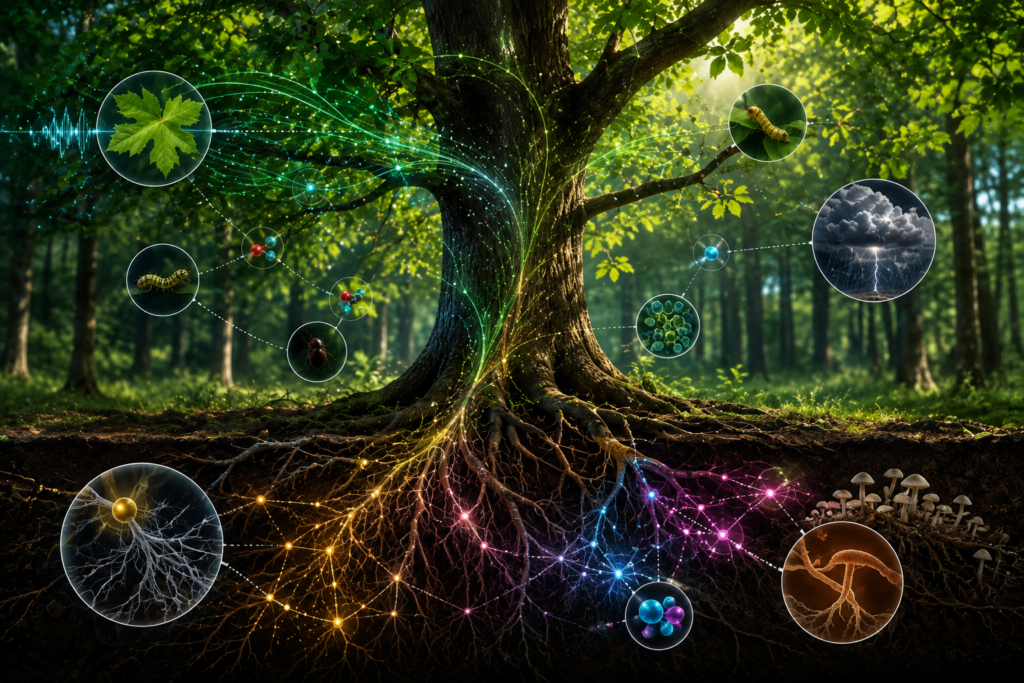
Roots release a variety of compounds into surrounding soil. These substances can attract, support, or influence microorganisms and fungi. In return, soil organisms can affect nutrient availability, root development, and plant health.
Do all trees communicate in the same way?
No. Signaling systems differ among plant species. A response that occurs in one tree may not occur in another, and environmental conditions can also change how a plant responds to a particular signal.
Why is tree communication important?
Plant signaling allows trees to detect environmental changes and coordinate their responses. It also helps explain interactions between trees, fungi, microorganisms, insects, and other organisms that contribute to the functioning of forests.
Conclusion
Trees may stand quietly in one place, but they are continuously sensing and responding to the world around them. Through hormones, electrical signals, chemical compounds, roots, vascular tissues, and relationships with fungi and microorganisms, trees can coordinate responses to drought, insects, sunlight, temperature, physical damage, and competition. These processes reveal that plants are highly responsive organisms with sophisticated biological systems.
The study of plant signaling also changes the way we understand forests. A forest is not simply a collection of individual trees competing for sunlight and water; it is a complex ecosystem filled with chemical, biological, and environmental interactions. Although trees do not communicate through language or conscious conversations, their signaling networks allow them to respond to one another and to their surroundings in remarkable ways. Continued research will help scientists understand these interactions more clearly and explain how forests can survive and adapt in a changing world.