
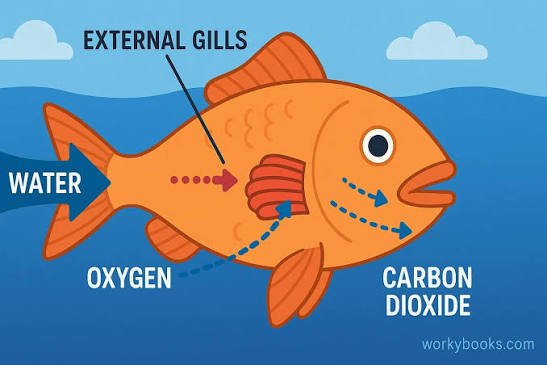
Fish live in an environment where humans cannot breathe normally. Instead of taking oxygen from the air with lungs, most fish obtain dissolved oxygen directly from water. Their bodies contain specialized organs called gills that allow them to extract this oxygen and release carbon dioxide back into the surrounding water.
The process may look simple when a fish opens and closes its mouth underwater, but there is a remarkable system working inside its body. Water continuously passes across delicate gill surfaces, where oxygen moves into the bloodstream. At the same time, carbon dioxide moves out of the blood and into the water. This efficient exchange allows fish to remain underwater for their entire lives without needing to breathe atmospheric air.
Why Do Fish Need Oxygen?
Like humans and other animals, fish need oxygen to release usable energy from food. Their cells perform cellular respiration, a series of chemical processes that allow nutrients to provide energy for movement, growth, repair, and other essential activities.
Without enough oxygen, fish cells cannot maintain normal activity for long. The brain, muscles, heart, and other organs all depend on a continuous supply. This means that even though fish live underwater, they still face the same basic biological requirement for oxygen as animals that breathe air.
Is There Oxygen in Water?
Water contains oxygen, but most of it is not present as the same type of oxygen gas found in the atmosphere. Some oxygen exists as part of the water molecules themselves, but fish cannot simply split water molecules apart to obtain the oxygen they need.
Instead, fish use oxygen that is dissolved between water molecules. This dissolved oxygen comes mainly from contact with the atmosphere and from photosynthetic organisms such as algae and aquatic plants. Its concentration can vary depending on temperature, movement, depth, and biological activity.
What Are Gills?
Gills are specialized respiratory organs found in fish and several other aquatic animals. They are usually located on either side of the head and protected by structures such as the operculum, commonly called the gill cover, in many bony fish.
Inside the gill area are thin structures containing an extensive network of blood vessels. These structures provide a large surface area where gases can move between water and blood. Their delicate design is one of the main reasons fish can extract oxygen so efficiently.
How Does Water Enter a Fish?
Most fish do not need to swallow water in the way humans swallow food. Instead, water enters through the mouth as the fish moves its mouth and throat in a coordinated pumping action.
The fish then moves the water backward across the gills before it exits through openings near the sides of the head. This creates a continuous flow of water over the respiratory surfaces.
Some fish can also use forward swimming to help move water across their gills. Species that constantly swim, including some sharks and other active fish, may rely heavily on water movement created by their swimming behavior.
The Role of the Gill Cover
In many bony fish, the gills are protected by a movable flap called the operculum. This structure helps control the direction of water movement through the gill chamber.
When the fish expands and contracts parts of its mouth and throat, pressure differences develop inside the mouth and gill cavity. These pressure changes help draw water in and push it across the gills.
The operculum therefore does more than protect delicate tissue. It is an important part of the fish’s ventilation system, helping maintain one-way water movement over the gill surfaces.
What Are Gill Filaments?
The main gill structures contain numerous thin projections called gill filaments. These filaments greatly increase the surface area available for gas exchange.
A large surface area is useful because more water and blood can come into close contact across the respiratory membrane. The greater the exchange surface, the more oxygen can potentially move into the bloodstream.
Gill filaments are delicate and highly specialized. Their structure allows fish to obtain oxygen efficiently while keeping the distance between water and blood extremely small.
What Are Gill Lamellae?
Each gill filament contains even smaller structures known as lamellae. These tiny plates create an enormous respiratory surface packed with small blood vessels.
The lamellae are arranged so that water can flow across them while blood circulates through the internal capillaries. This arrangement provides excellent conditions for oxygen and carbon dioxide exchange.
Although individual lamellae are microscopic, millions of these small surfaces can collectively provide a very large area for gas exchange. This is one of the key adaptations that makes fish gills so effective.
How Does Oxygen Enter the Blood?
When water flows over the gill lamellae, oxygen dissolved in the water comes into contact with the thin respiratory surface. Oxygen concentration is generally higher in the incoming water than in the blood arriving at the gills.
Because of this difference in concentration, oxygen naturally moves across the thin barrier and into the bloodstream. The process occurs through diffusion, meaning molecules move from areas of higher concentration toward areas of lower concentration.
Once oxygen enters the blood, it can be transported throughout the fish’s body. Carbon dioxide produced by the body’s cells travels in the opposite general direction and leaves the blood through the gills.
What Is Countercurrent Exchange?
One of the most important features of fish gills is a process called countercurrent exchange. Water flows across the gill surface in one direction, while blood inside the gill capillaries flows in the opposite direction.
This arrangement helps maintain a concentration difference between the water and blood along much of the gill surface. Because the blood continually encounters water containing more oxygen than the blood itself, oxygen can keep moving into the bloodstream.
If water and blood moved in the same direction, the concentration difference would become smaller much sooner. Countercurrent flow therefore allows fish to extract a remarkably high proportion of available oxygen from the water.
Why Is Countercurrent Exchange So Effective?
Imagine water entering the gills with a relatively high oxygen concentration. Blood arriving at the same region contains less oxygen. Oxygen therefore moves from the water into the blood.
As the water travels onward, it loses some oxygen. However, the blood moving in the opposite direction is also becoming increasingly oxygenated. This means the blood can continue encountering water that contains slightly more oxygen than the blood at each point along the exchange surface.
The concentration gradient is therefore maintained across much of the gill. This simple but powerful arrangement greatly improves the efficiency of oxygen extraction.
How Does Carbon Dioxide Leave the Fish?
Fish cells produce carbon dioxide as a waste product of cellular respiration. This carbon dioxide must be transported away from tissues so that the body’s internal chemistry remains balanced.
Blood carries carbon dioxide toward the gills. At the gill surface, the concentration conditions favor movement of carbon dioxide from the blood into the surrounding water.
The carbon dioxide then leaves the fish as water passes through the gill chamber. In this way, the gills perform two important jobs at once: bringing oxygen into the body and removing carbon dioxide.
Why Can’t Humans Breathe Through Gills?
Human lungs and fish gills are adapted to very different environments. Lungs are designed to exchange gases with air, while gills are specialized for extracting dissolved oxygen from water.
Gills depend on a large, delicate surface that must remain moist and supported by water. Outside water, the thin structures of many fish gills can stick together and lose their normal shape, making gas exchange much less effective.
Human lungs, in contrast, contain internal air-filled structures that provide a large surface for gas exchange. Their design is suited to breathing air rather than extracting oxygen from water.
Why Is Breathing Underwater Difficult for Humans?
Water contains much less available oxygen per volume than air, and extracting that oxygen requires a specialized exchange surface. Human lungs are not designed to process water in the way fish gills process it.
Even if water enters the lungs, the lungs cannot efficiently extract oxygen from it. Water can also interfere with normal lung function and prevent effective air exchange.
Fish avoid this problem because their gills are specifically adapted to maintain a large exchange surface in water. Their respiratory system evolved around the physical properties of the aquatic environment.
Do All Fish Have the Same Type of Gills?
Fish gills follow the same basic principle of gas exchange, but their structures and breathing strategies can vary between species.
Different fish live in different environments and face different oxygen conditions. Some live in fast-moving streams, others in still ponds, deep ocean habitats, coral reefs, or muddy environments. Their respiratory adaptations reflect these differences.
Some fish can also supplement gill breathing with additional structures or behaviors. These adaptations allow certain species to survive in environments where dissolved oxygen may be limited.
How Does Water Temperature Affect Fish Breathing?
Temperature can influence the amount of oxygen that water can hold. Generally, colder water can contain more dissolved oxygen than warmer water.
At the same time, fish are ectothermic animals, meaning their body temperature is strongly influenced by the surrounding environment. Warmer temperatures can increase metabolic activity in many fish, which may increase their oxygen demand.
This creates an important relationship between temperature and oxygen availability. Warm water may contain less dissolved oxygen while the fish may require more oxygen, potentially making stressful conditions more challenging.
Why Do Fish Breathe Faster in Low-Oxygen Water?
When dissolved oxygen becomes limited, fish may increase the movement of water across their gills. Faster ventilation can help bring more water into contact with the respiratory surfaces.
Some fish may also increase the rate at which their gill covers move. This can be noticeable in aquariums when water quality is poor or oxygen levels fall.
If oxygen becomes severely depleted, however, increased breathing cannot solve the problem indefinitely. Fish may become stressed, move toward areas with better water conditions, or suffer serious physiological consequences if the shortage continues.
What Happens in Stagnant Water?
Still water does not automatically lack oxygen, but stagnant environments can sometimes develop low oxygen levels. Decomposition by microorganisms can consume dissolved oxygen, particularly when large amounts of organic material accumulate.
Aquatic plants and algae can produce oxygen through photosynthesis during daylight, but they also consume oxygen through respiration. At night, photosynthesis stops while respiration continues, which can influence oxygen levels.
Fish living in such environments may therefore experience changing oxygen conditions throughout the day. Their ability to respond to these fluctuations can be important for survival.
Can Fish Breathe Air?
Most fish are adapted primarily to extracting oxygen from water, but some species have evolved the ability to obtain oxygen from air as well.
Certain fish have specialized organs or modified parts of their digestive or respiratory systems that allow them to use atmospheric oxygen. These adaptations can be especially useful in warm, shallow, or poorly oxygenated environments.
Air-breathing fish demonstrate that fish respiration is more diverse than the simple image of every fish relying exclusively on ordinary gills. Evolution has produced several different solutions to the challenge of obtaining oxygen.
Why Do Some Fish Come Near the Water’s Surface?
Fish may approach the surface for several reasons, including feeding, temperature changes, environmental conditions, or low oxygen levels deeper in the water.
If oxygen concentration is especially low in deeper water, some species may move toward areas where water has more contact with the atmosphere. Surface waters can sometimes contain higher oxygen levels because of air-water exchange and photosynthetic activity.
However, surface behavior does not automatically mean a fish is struggling to breathe. The reason depends on the species and the conditions of its environment.
How Do Sharks Breathe?
Sharks also use gills for extracting oxygen from water, but their breathing mechanisms can vary between species.
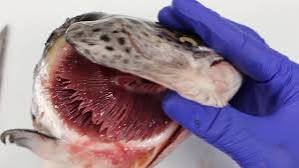
Some sharks can actively pump water through their mouths and across their gills, while others rely heavily on swimming to maintain water flow. In species that depend strongly on continuous forward movement, stopping for long periods can interfere with efficient ventilation.
This is why shark respiration is often more complicated than the simple idea that all sharks must constantly swim. Different shark species have evolved different methods of moving water across their gills.
What Happens If a Fish Leaves the Water?
A fish taken out of water may begin struggling because its gills can no longer function normally. Without water flowing across the gill surfaces, oxygen exchange becomes severely impaired.
In many bony fish, the delicate gill filaments can collapse, stick together, or dry out when exposed to air. This reduces the effective surface area available for gas exchange.
Some fish have adaptations that allow them to survive outside water for periods of time, but most ordinary fish cannot remain out of water indefinitely. Their respiratory organs are fundamentally designed for an aquatic environment.
Why Are Fish Gills So Delicate?
Efficient gas exchange requires a thin barrier between the environment and the bloodstream. The thinner this barrier is, the easier it can be for gases to diffuse across it.
Fish gills therefore contain extremely delicate structures with extensive networks of tiny blood vessels. This design maximizes gas exchange but also makes the tissue vulnerable to physical damage and poor water conditions.
Sediment, pollutants, parasites, or other environmental problems can interfere with gill function. Because the gills are directly exposed to the surrounding water, changes in water quality can have immediate effects on fish respiration.
How Does Pollution Affect Fish Gills?
Water pollution can interfere with the delicate surfaces of fish gills. Suspended particles may irritate the tissue, while certain chemicals can damage cells or interfere with normal physiological processes.
Poor water quality can also affect dissolved oxygen levels. If pollution encourages excessive decomposition or changes aquatic ecosystems, the amount of oxygen available to fish may decrease.
This is one reason clean water is essential for aquatic life. Fish depend directly on the physical and chemical properties of their surroundings, and healthy gills require an environment suitable for normal gas exchange.
Why Do Aquariums Need Proper Oxygen Levels?
Fish kept in aquariums depend on the oxygen dissolved in the water. Oxygen enters aquarium water through contact with the air and can also be influenced by plants, water movement, and filtration systems.
Water movement is particularly useful because it increases contact between water and air and helps distribute oxygen throughout the aquarium. In crowded tanks, oxygen demand can become higher because more animals are using the available oxygen.
Proper aquarium maintenance therefore involves more than simply providing food. Water quality, temperature, circulation, and stocking levels can all influence whether fish have suitable conditions for respiration.
How Do Fish Know Where Oxygen Is Available?
Fish do not need to consciously understand oxygen concentration in the way humans might measure it. Their bodies respond to changes in environmental conditions through physiological and behavioral mechanisms.
When oxygen becomes limited, changes in breathing movements and activity can occur. Some species may move toward areas where oxygen levels are higher.
These responses can improve their chances of finding suitable water. Over long periods, natural selection has also shaped fish species to survive within the oxygen conditions typical of their habitats.
The Evolution of Fish Gills
Gills are the result of a long evolutionary history. Early aquatic vertebrates developed structures that allowed them to exchange gases efficiently with water, and these structures became increasingly specialized in different groups.
Modern fish display enormous diversity in gill structure and respiratory strategies. Their gills are adapted to different habitats, body sizes, swimming styles, and oxygen conditions.
The basic challenge remains the same: obtain enough oxygen from water while removing carbon dioxide. The variety of solutions found among fish shows how evolution can modify a common biological principle to suit different environments.
Why Gills Are More Efficient Than They Look
A fish’s gills may seem like simple red structures hidden beneath the gill cover, but their microscopic organization is extremely sophisticated. Numerous filaments and lamellae create a huge exchange surface within a relatively compact space.
Blood vessels are positioned close to the water, allowing gases to diffuse across a very short distance. Countercurrent exchange then improves the efficiency of oxygen uptake.
The entire system works continuously as water enters the mouth, passes over the gills, and leaves the body. Every breath-like pumping movement helps refresh the water surrounding the respiratory surfaces.
What Makes Fish Respiration Different From Human Breathing?
Humans take air into the lungs and remove it through the same general pathway. Fish instead move water across their gills, creating a flow that allows dissolved gases to exchange with the bloodstream.
The two systems solve the same biological problem but are designed for different environments. Human lungs are optimized for air, while fish gills are optimized for water.
Both systems rely on diffusion, thin respiratory surfaces, blood circulation, and concentration differences. Their major difference is the environment from which oxygen must be obtained.
People Also Ask
How do fish breathe underwater?
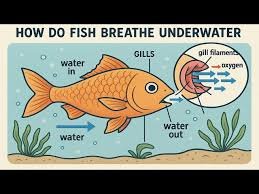
Fish breathe underwater by passing water across their gills. Dissolved oxygen moves from the water into the fish’s bloodstream, while carbon dioxide moves from the blood into the water.
Do fish breathe water?
Fish do not breathe the water molecules themselves. They extract oxygen that is dissolved in the water using their specialized gills.
Why can’t humans breathe underwater?
Human lungs are designed to exchange gases with air rather than extract dissolved oxygen from water. They cannot efficiently process water for respiration.
What do fish use instead of lungs?
Most fish use gills. Gills contain large, thin surfaces with many blood vessels that allow oxygen and carbon dioxide to move between water and blood.
How do gills get oxygen?
Water containing dissolved oxygen flows across the gill filaments and lamellae. Oxygen then diffuses across the thin respiratory surface and enters the bloodstream.
Why do fish need to keep moving their mouths?
Mouth and throat movements help pump water across the gills. This continually brings fresh water containing dissolved oxygen into contact with the respiratory surfaces.
Frequently Asked Questions
Can fish breathe in water with no oxygen?
No. Fish require dissolved oxygen for normal aerobic respiration. If the oxygen concentration becomes extremely low, they can become stressed, lose normal function, and eventually die.
Do fish breathe faster when oxygen is low?
Many fish increase their ventilation rate when oxygen levels decrease. Moving more water across the gills can help them obtain additional oxygen, although this response has limits.
Why are fish gills red?
Fish gills contain a dense network of blood vessels close to the surface. The blood can make the gill tissue appear red and allows oxygen to be transported efficiently.
How much oxygen can fish extract from water?
The amount varies among species and environmental conditions. The countercurrent arrangement of water and blood flow allows many fish to extract oxygen very efficiently from the water passing over their gills.
Can fish breathe outside water?
Most fish cannot breathe effectively outside water for long because their gills are adapted to remain supported and functioning in an aquatic environment. Some specialized species have adaptations that allow limited air breathing.
Why is cold water often better for fish respiration?
Cold water can generally hold more dissolved oxygen than warm water. However, temperature also affects fish metabolism, so the overall effect on a particular species depends on its biology and environment.
Do fish breathe while sleeping?
Fish continue carrying out respiration while resting. Their metabolism may slow, but their cells still require oxygen, so water generally continues moving across their respiratory surfaces.
How does pollution affect fish breathing?
Pollution can damage delicate gill tissues, interfere with normal physiology, or reduce dissolved oxygen in water. Severe water-quality problems can therefore make respiration difficult for fish.
Conclusion
Fish breathe underwater through highly specialized gills that extract dissolved oxygen from water and remove carbon dioxide from the bloodstream. Water enters through the mouth, passes across delicate gill filaments and lamellae, and leaves through the gill openings. At the microscopic level, oxygen moves into the blood by diffusion while countercurrent exchange keeps the process efficient across much of the gill surface.
The gill is an impressive example of biological adaptation. Its enormous exchange surface, dense network of blood vessels, and carefully arranged water and blood flow allow fish to obtain oxygen from an environment where humans cannot breathe. From tiny aquarium fish to enormous ocean species, these respiratory systems demonstrate how life can evolve specialized solutions for surviving in very different environments.