
Ocean waves are one of the most familiar sights on Earth, but the science behind them is surprisingly complex. From gentle ripples along a quiet beach to enormous waves crossing an ocean basin, waves are created when energy moves through water. Although the water itself may rise, fall, and move in circular patterns, the energy can travel much farther than individual water particles.
The most common ocean waves are generated by wind blowing across the surface of the sea. As wind transfers energy to the water, small ripples develop and gradually become larger waves when the wind continues to act on them. However, wind is not the only possible cause. Earthquakes, underwater landslides, volcanic activity, tides, and even objects entering the water can produce different types of waves. Understanding these movements helps explain everything from ordinary beach waves to powerful tsunamis.
What Is an Ocean Wave?
An ocean wave is a moving pattern of energy that travels through seawater. It is not simply a large amount of water traveling from one location to another. Instead, the wave transfers energy while individual water particles generally move in repeated paths.
When you watch a wave approaching a beach, it may appear that the water itself is traveling toward you. In reality, much of the water is moving in an orbital or back-and-forth pattern while the wave’s energy progresses forward. This distinction is important for understanding how waves form and why they eventually break near shore.
How Does Wind Create Ocean Waves?
Wind is the main source of most waves found on the ocean surface. When moving air passes over the water, friction and pressure differences disturb the normally smooth surface. Tiny ripples appear first, creating small uneven areas that give the wind an even better surface to push against.
As the wind continues blowing, it transfers more energy into these ripples. The small disturbances grow into larger waves, provided that the wind has enough speed, time, and distance over which to act. The longer and stronger the wind blows across open water, the greater the potential for waves to develop.
The Three Main Factors Behind Wind Waves
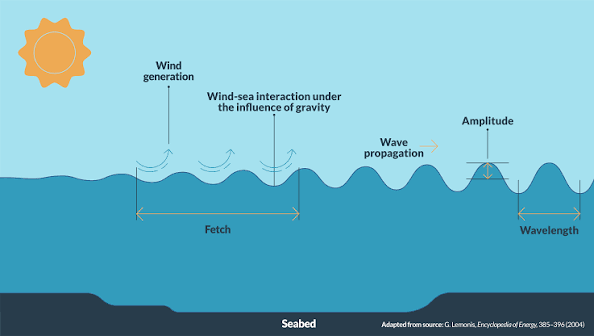
The size of a wind-generated wave depends on several conditions rather than wind speed alone. Scientists commonly consider wind strength, the duration of the wind, and the fetch, which is the uninterrupted distance over which the wind blows across the water.
A strong wind blowing for only a few minutes over a short distance may create relatively small waves. On the other hand, a strong wind that continues for many hours across hundreds or thousands of kilometers of open ocean can produce much larger and more organized waves.
Wind Speed
Faster winds generally transfer more energy to the ocean surface. Strong winds can disturb the water more intensely and build larger waves when other conditions are suitable.
However, wind speed does not work independently. Even very strong winds cannot produce extremely large waves if they have insufficient time or distance to interact with the water. This is why open-ocean storms can generate much larger waves than short gusts near a sheltered coastline.
Wind Duration
The amount of time the wind continues blowing is another important factor. As long as the wind remains capable of transferring energy into the waves, the wave field can continue developing.
If the wind stops quickly, the waves may not have enough time to grow significantly. When strong winds persist for many hours, energy continues entering the ocean surface, allowing waves to become larger and more organized.
Fetch
Fetch refers to the uninterrupted stretch of water over which wind can blow in approximately the same direction. A large fetch gives the wind more opportunity to transfer energy into the sea.
This explains why large ocean basins can produce powerful waves during major storms. There may be enormous distances of open water available for the wind to interact with before the waves reach land.
How Does Wave Energy Move?
The movement of wave energy is one of the most interesting aspects of ocean waves. Imagine dropping a small object into calm water. Circular ripples spread outward from the disturbance even though the water particles themselves do not travel outward with the ripple over long distances.
Ocean waves behave according to the same basic principle, although their structure is much more complicated. Energy moves through the water while particles undergo repeated movements. The exact motion depends on factors such as wave size, depth, and the characteristics of the water.
Do Water Particles Travel With the Wave?
Water particles do move as a wave passes, but they generally do not travel forward at the same speed and distance as the wave itself. In deep water, particles near the surface tend to move in roughly circular orbits.
As a wave passes, a particle may move upward, forward, downward, and backward before returning close to its original position. The wave continues progressing while the particle completes this repeating motion.
This is why it is useful to think of an ocean wave as the movement of energy rather than simply the movement of water. The wave can travel across a large area even though individual water particles mostly remain within a relatively limited region.
What Happens to Waves in Deep Water?
In deep water, waves can travel across enormous distances with relatively little interaction with the ocean floor. Their energy can move through the upper part of the water column while the deeper water remains comparatively unaffected.
Large swells can therefore travel far beyond the storm that originally created them. A storm may occur thousands of kilometers away, yet waves generated by that storm can eventually reach a distant coastline after traveling across the ocean.
What Is an Ocean Swell?
A swell is a group of relatively organized waves that has moved away from the area where the waves were originally generated. Swells often have smoother shapes and more regular spacing than waves directly under a strong local wind.
A distant storm can produce waves that travel outward in different directions. As these waves move away from the storm, shorter and less organized waves may lose energy more quickly, while longer-period waves can travel great distances. The result can be a recognizable swell arriving at a coastline long after the original storm has passed.
Why Do Waves Break Near the Shore?
Ocean waves behave differently as they approach shallow water. In deep water, the wave can move without strongly interacting with the seafloor. Near the coast, however, the bottom begins to influence the movement of the wave.
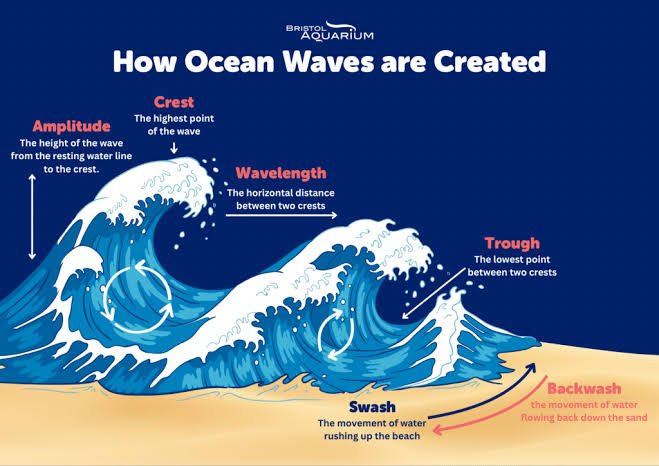
As the water becomes shallower, the lower part of the wave experiences increasing friction and resistance from the seabed. The wave slows down while its energy becomes concentrated into a smaller water depth. The wave height can increase relative to its wavelength, eventually making the wave unstable.
When the crest moves faster than the water beneath it can support, the wave tips forward and breaks. This produces the familiar breaking waves seen along beaches.
How Does the Ocean Floor Affect Waves?
The shape and depth of the seabed can dramatically influence how waves behave. A gradually sloping sandy beach may cause waves to slow and break progressively, while a steep underwater slope can cause waves to change more abruptly.
Underwater ridges, sandbars, reefs, and trenches can also alter wave direction and height. These features can focus wave energy in certain locations while reducing it elsewhere. This is one reason why neighboring sections of the same coastline can experience very different wave conditions.
What Is Wave Refraction?
Wave refraction occurs when different parts of a wave move at different speeds because they encounter different water depths. As a wave approaches an irregular coastline, one part may enter shallow water before another part.
The shallow portion slows down first, causing the wave crest to bend. Over time, the wave may become more aligned with the shoreline. This bending helps explain why wave energy is often distributed along beaches in complex patterns.
What Causes Very Large Ocean Waves?
Very large waves can develop when enormous amounts of energy are transferred into the ocean. Powerful storms with strong winds, long durations, and large fetches can create exceptionally high waves.
However, extremely large waves can also be produced by sudden movements of water. Underwater earthquakes and landslides can displace huge volumes of seawater, generating waves that behave differently from ordinary wind waves.
What Is a Tsunami?
A tsunami is a series of long waves created by a large-scale displacement of water, often caused by an underwater earthquake. Underwater landslides, volcanic eruptions, and other geological events can also generate tsunamis.
Unlike ordinary wind-generated waves, tsunamis can have extremely long wavelengths. In deep water, they may travel rapidly while remaining relatively low in height. As they approach shallow coastal areas, their speed decreases and their energy can become concentrated, causing the water level and wave height to increase.
How Are Tsunamis Different From Normal Waves?
Wind-generated waves mainly involve energy transferred to the ocean surface by atmospheric movement. Their wavelengths and periods are generally much smaller than those of tsunamis.
A tsunami involves movement through a much larger portion of the water column. Because its wavelength can be extremely long, the entire wave system can contain enormous amounts of energy and travel across ocean basins.
This difference is important because a tsunami may not look like a giant breaking wave when it reaches the coast. It can instead appear as a rapidly rising or advancing body of water, sometimes followed by repeated waves.
Can Underwater Landslides Create Waves?
Yes, underwater landslides can displace seawater and generate powerful waves. When a large mass of sediment or rock suddenly moves downward along the seafloor, it pushes against the surrounding water.
The resulting disturbance can spread outward as waves. The size and reach of these waves depend on the volume of displaced material, the speed of the movement, the depth of the water, and the shape of the surrounding seafloor.
Can Volcanoes Cause Ocean Waves?
Volcanic activity can also disturb seawater. An eruption that occurs beneath the ocean or near a coastline can displace water directly or trigger landslides that move into the sea.
Some volcanic events can produce significant waves, particularly when large quantities of material suddenly enter or shift through the water. These events are less common than ordinary wind-generated waves but demonstrate how many different forms of energy can affect the ocean.
What Are Tidal Waves?
The term “tidal wave” is sometimes used in everyday language to describe a tsunami, but the two are not the same thing. Tides are caused primarily by the gravitational effects of the Moon and Sun, along with Earth’s rotation and the shape of ocean basins.
Tidal movements can create currents and changes in sea level, but a tsunami results from a sudden displacement of water. For scientific accuracy, the term tsunami is preferred when describing waves caused by underwater geological disturbances.
How Do Tides Differ From Ocean Waves?
Tides involve large-scale, predictable changes in ocean water levels that occur over much longer periods than ordinary surface waves. Their timing is strongly influenced by astronomical forces.
Wind waves, by comparison, are usually generated by atmospheric conditions and can change rapidly. A beach can experience small waves during one period and much larger waves later because of changing winds or distant swells.
Why Are Some Waves Bigger Than Others?
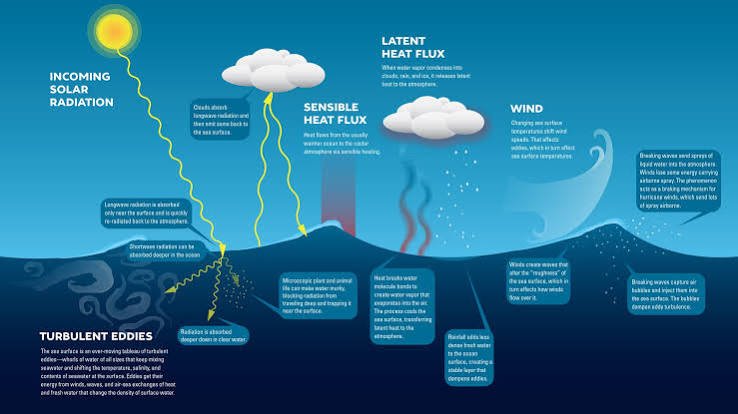
Wave height is influenced by the amount of energy transferred into the water and the conditions through which the waves travel. Stronger winds, longer wind duration, and larger fetch generally provide greater opportunities for wave growth.
Once waves leave their generation area, their size can also be influenced by interactions with other waves, changes in water depth, and the shape of the seafloor. This is why wave conditions can vary considerably from one coastline to another.
What Are Rogue Waves?
Rogue waves are unusually large waves that appear much bigger than the surrounding sea state. They were once considered mostly maritime folklore, but observations and measurements have demonstrated that exceptionally large individual waves can occur.
Several physical processes may contribute to their formation. Wave interactions can sometimes concentrate energy into a particularly large crest, while ocean currents and changing wave patterns can further influence wave height. Rogue waves remain an important subject of oceanographic research because of their potential danger to ships and offshore structures.
Can Waves Travel Across an Entire Ocean?
Yes, wave energy can travel enormous distances across an ocean. Swells generated by distant storms can cross large portions of ocean basins before reaching a coastline.
As waves travel, they gradually change because of interactions with other waves, ocean currents, and variations in water depth. Nevertheless, long-period swells can retain their organized patterns over very large distances, allowing distant storms to influence coastal conditions far away.
What Happens When Waves Meet Each Other?
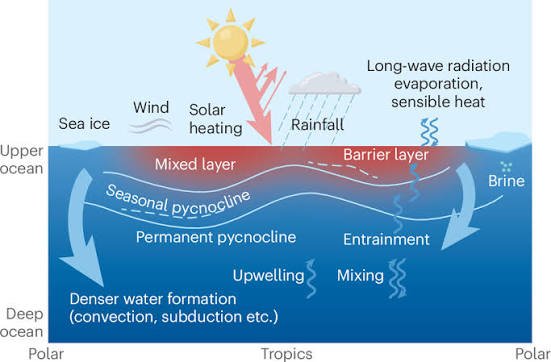
Ocean waves do not always travel alone. When waves from different sources meet, they can interact through a process called interference.
Sometimes their crests combine, temporarily producing a larger wave. At other times, a crest may overlap with a trough, reducing the overall height. This interaction constantly changes the appearance of the ocean surface and contributes to the complex pattern of waves observed at sea.
Why Are Waves Important to Marine Ecosystems?
Waves are not simply physical movements of water. They influence coastal ecosystems by mixing water, transporting nutrients, moving sediments, and affecting the distribution of organisms.
Wave action can also shape beaches, cliffs, reefs, and other coastal environments. Over long periods, repeated wave activity can move sand along shorelines and contribute to erosion, while other processes can transport sediment into new areas.
How Do Waves Shape Coastlines?
Every breaking wave transfers energy to the coastline. Depending on the strength of the waves and the geological structure of the shore, this energy can remove sediment, move sand, or gradually wear down rock.
Wave action is therefore one of the major forces responsible for changing coastal landscapes. Beaches can become narrower or wider, cliffs can retreat, and sandbars can shift as waves interact with the shoreline over time.
People Also Ask (PAA)
What is the main cause of ocean waves?
Wind is the main cause of most ordinary ocean surface waves. Moving air transfers energy to the water, creating disturbances that can grow into waves when suitable wind conditions continue.
Do ocean waves move water or energy?
Ocean waves primarily transfer energy through the water. Individual water particles move in repeated patterns rather than traveling forward with the wave over the same distance.
Why do waves get bigger near the beach?
As waves enter shallow water, they interact with the seafloor, slow down, and become compressed. Their height can increase until the wave becomes unstable and breaks.
What causes waves in the middle of the ocean?
Most waves in the open ocean are produced by wind. Large storms can generate waves that organize into swells and travel far beyond the storm itself.
Can an earthquake cause ocean waves?
Yes. An underwater earthquake can suddenly displace a large volume of seawater and generate a tsunami, particularly when the earthquake causes significant vertical movement of the seafloor.
Why are some ocean waves calm while others are huge?
Wave conditions depend on wind speed, wind duration, fetch, existing swells, currents, and water depth. Different combinations of these factors produce different wave sizes and patterns.
Frequently Asked Questions (FAQ)
1. How fast do ocean waves travel?
Wave speed varies according to the wave’s characteristics and the depth of the water. Long waves can travel particularly quickly in deep water, while ordinary wind waves change speed as they approach shallow coastal areas.
2. Do waves travel faster in deep or shallow water?
Many ordinary waves travel faster in deep water than they do after entering shallow water. As the water becomes shallow enough for the seabed to influence the wave, the wave slows and changes shape.
3. Why do waves always come toward the beach?
Waves do not always travel directly toward a beach. Their direction depends on where they were generated and how currents and the seafloor affect them. Refraction can gradually turn waves toward a coastline.
4. Can waves exist without wind?
Yes. Waves can be created by earthquakes, landslides, volcanic activity, tides, and other disturbances. However, wind is responsible for most of the ordinary waves seen on ocean surfaces.
5. What makes a wave break?
A wave usually breaks when it becomes too steep to remain stable. Near shore, the seabed slows the lower part of the wave while the crest continues forward, causing the crest to collapse.
6. What is the difference between a wave and a swell?
A wave is a general term for a moving disturbance in water. A swell usually refers to organized waves that have traveled away from their generation area and often have longer periods and more regular spacing.
7. Are bigger waves always more dangerous?
Not necessarily, but larger waves generally contain more energy and can present greater hazards to swimmers, boats, and coastal structures. Wave shape, current conditions, water depth, and the location also affect danger.
8. How do scientists measure ocean waves?
Scientists can measure wave height, wavelength, period, direction, and other characteristics using instruments such as buoys, radar, satellites, and specialized oceanographic equipment. These measurements help researchers understand changing ocean conditions.
Conclusion
Ocean waves are created when energy moves through seawater, with wind being the main source of the waves commonly seen across the ocean. Wind transfers energy to the surface, while factors such as wind speed, duration, and fetch determine how large and organized the waves can become. Once generated, wave energy can travel great distances as swells, while the individual water particles mainly move in repeated patterns rather than traveling forward with the wave.
The behavior of waves becomes even more fascinating when they approach land. Shallow water, underwater landscapes, currents, and coastal shapes can transform their speed, direction, and height before they finally break along the shore. Other events, including earthquakes and underwater landslides, can create much longer and more powerful waves known as tsunamis. Together, these processes show that ocean waves are not simply moving water but a complex transfer of energy that constantly shapes Earth’s oceans and coastlines.