
Rain is one of the most common forms of weather on Earth, yet every raindrop is the result of a remarkable chain of physical processes happening high above the ground. The rain that falls from a cloud begins with water that has changed from a liquid into an invisible gas called water vapor. As this vapor rises into the atmosphere, it cools and eventually becomes part of the process that produces clouds and precipitation.
The formation of rain depends on temperature, humidity, air movement, atmospheric pressure, and tiny particles floating through the atmosphere. Water vapor must first condense into microscopic droplets or form ice crystals inside clouds. These tiny particles then grow through several processes until they become heavy enough for gravity to pull them toward Earth. Understanding this journey explains why some clouds produce gentle rain while others create heavy showers and thunderstorms.
Where Does the Water in Rain Come From?
Most of the water involved in rainfall begins at Earth’s surface. Oceans are the largest source because they cover most of the planet, but lakes, rivers, moist soil, plants, and other wet surfaces also contribute water vapor to the atmosphere.
The Sun provides the energy needed to move this water into the air. When sunlight warms a surface, some liquid water gains enough energy for individual molecules to escape into the atmosphere as water vapor. This continuous movement of water from Earth’s surface into the atmosphere is an essential part of the water cycle.
What Is Water Vapor?
Water vapor is the gaseous form of water. Unlike visible liquid droplets, individual water vapor molecules are too small to see under ordinary conditions, which is why evaporation itself appears invisible.
The atmosphere can contain different amounts of water vapor depending on temperature and location. Warm air can generally hold more water vapor than cold air. When air becomes sufficiently saturated, additional cooling can cause some of the vapor to condense into liquid droplets or deposit as ice.
How Does Evaporation Start the Rain Process?
Evaporation occurs when water molecules at the surface of a liquid gain enough energy to escape into the surrounding air. The Sun is the main energy source driving this process across Earth’s surface.
The rate of evaporation depends on several factors, including temperature, humidity, wind, and the amount of exposed water. Warm, dry, moving air can encourage faster evaporation because it can accept more water vapor from the surface.
How Does Water Vapor Rise Into the Atmosphere?
Water vapor does not automatically rise simply because it is water. Instead, it becomes part of moving air and can be carried upward through several atmospheric processes. Warm air is often less dense than surrounding cooler air, so it can rise when atmospheric conditions allow.
Air can also be forced upward when it encounters mountains, weather fronts, or areas where winds converge. As moist air rises, it expands because atmospheric pressure decreases with altitude. This expansion causes the air to cool, bringing it closer to the conditions required for condensation.
What Happens When Rising Air Cools?
As moist air rises, the surrounding atmospheric pressure becomes lower. The rising air expands, and expansion causes its temperature to decrease. This cooling process is one of the most important steps in cloud formation.
Eventually, the air may reach a temperature at which it can no longer hold all of its water vapor in gaseous form. At this point, the atmosphere becomes saturated. Water vapor can then begin changing into tiny liquid droplets or ice particles.
What Is Condensation?
Condensation is the process in which water vapor changes into liquid water. It happens when water molecules lose enough energy to come together and form microscopic droplets.
In the atmosphere, condensation usually requires surfaces known as condensation nuclei. These can include tiny particles such as dust, sea salt, smoke particles, and other microscopic material. Water vapor can collect around these particles and form extremely small droplets.
Why Are Clouds Important for Rain?
Clouds are collections of tiny water droplets, ice crystals, or a mixture of both suspended in the atmosphere. A cloud can contain an enormous number of these microscopic particles, but individual droplets are usually far too small to fall rapidly toward the ground.
For rain to develop, these droplets or ice particles must grow considerably. Cloud formation therefore does not automatically mean that rain will occur. A cloud may remain suspended for a long time without producing measurable precipitation if its particles do not grow large enough.
How Do Tiny Cloud Droplets Become Raindrops?
Cloud droplets begin extremely small. To become raindrops, they must collect additional water through processes that increase their size and mass.
In warmer clouds, droplets can collide with one another as they move through turbulent air. Some collisions cause droplets to merge into larger drops. In colder clouds, ice crystals can grow and eventually contribute to precipitation through a different process involving water vapor, ice, and supercooled droplets.
What Is Collision and Coalescence?
Collision and coalescence is an important process in clouds that contain liquid water. As droplets move through the cloud, differences in their sizes and speeds can cause them to collide.
When two droplets collide successfully, they may merge into one larger droplet. That larger droplet can then collide with other droplets and continue growing. Over time, repeated collisions can produce particles large enough to begin falling through the cloud.
Why Don’t Tiny Cloud Droplets Fall Immediately?
Gravity acts on every water droplet, but microscopic cloud droplets are so small that air resistance strongly affects their movement. They can remain suspended because upward-moving air currents and atmospheric turbulence can balance or exceed their downward settling speed.
As droplets become larger, gravity becomes increasingly important. Eventually, a sufficiently large droplet can fall faster than surrounding air currents can keep it suspended. This marks an important transition from a microscopic cloud particle to a precipitation particle.
How Does Ice Help Create Rain?
Many clouds contain ice crystals even when the temperature near the Earth’s surface is above freezing. High-altitude parts of clouds can be cold enough for ice to form.
Ice crystals can grow by collecting water vapor from the surrounding air. They may also interact with supercooled liquid droplets. As ice particles grow, they can become heavy enough to fall through the cloud. Depending on the temperature they encounter on their journey downward, they may eventually reach the ground as snow, sleet, or rain.
What Is the Bergeron Process?
The Bergeron process is an important mechanism for precipitation formation in cold clouds containing both ice crystals and supercooled water droplets. Water vapor behaves differently around ice and liquid water, allowing ice crystals to grow under suitable conditions.
As ice crystals increase in size, they can eventually become heavy enough to fall. During their descent, they may pass through warmer layers of air and melt. If the melted particles reach the ground as liquid water, they become raindrops.
Can Rain Form in Warm Clouds?
Yes. Rain does not always require ice crystals. In warm clouds, where temperatures remain above freezing throughout much of the cloud, precipitation can develop through collision and coalescence.
Large droplets move differently from small droplets and can collide with them as they fall. Turbulent air can increase the number of collisions. When enough droplets merge and become large enough, they can begin descending toward the surface.
Why Does Rain Fall From Clouds?
Rain falls because gravity eventually becomes stronger than the forces keeping large water droplets suspended. Once a droplet reaches sufficient size, its downward acceleration causes it to move through the cloud.
As it falls, the raindrop encounters air resistance. This resistance prevents it from accelerating indefinitely. Eventually, the drop may approach a terminal falling speed where the downward force of gravity is balanced by aerodynamic drag.
What Happens to a Raindrop While It Falls?
A falling raindrop is not simply a perfect sphere traveling unchanged toward the ground. As its speed increases, air pressure and drag act on its surface and influence its shape.
Small drops can remain relatively rounded, while larger drops may become flattened or develop more complex shapes. Very large drops can become unstable and break apart into smaller droplets. This means a raindrop can change considerably during its journey from cloud to ground.
Why Do Raindrops Have Different Sizes?
Rainfall contains droplets of many different sizes. Some are relatively tiny, while others are much larger. Their sizes depend on how they formed, how many collisions they experienced, and what happened to them while falling.
Cloud conditions also change from one location to another. Strong turbulence, abundant moisture, and active cloud growth can create different precipitation particles compared with a calm, shallow cloud. This produces variation in the intensity and character of rainfall.
What Determines How Heavy the Rain Is?
Rainfall intensity depends on how much water is being converted into precipitation and how quickly that precipitation reaches the ground. A cloud with strong upward motion and abundant moisture can support rapid development of precipitation particles.
Thunderstorms can produce especially intense rainfall because powerful rising air currents transport warm, moist air upward. This supplies the cloud with water vapor and creates conditions favorable for rapid condensation, droplet growth, and precipitation.
Why Do Some Clouds Produce No Rain?
A cloud can contain millions or billions of tiny water droplets without producing rainfall. The droplets may simply be too small to overcome the effects of air resistance and remain suspended within the cloud.
For rain to reach the ground, precipitation particles must grow enough to fall through the atmosphere. If they evaporate before reaching the surface, the cloud may appear to produce rain even though no water actually reaches the ground.
What Is Virga?
Virga is precipitation that falls from a cloud but evaporates or sublimates before reaching Earth’s surface. It often appears as streaks extending downward from clouds without visible rainfall at ground level.
Virga is more common when the air below a cloud is relatively dry. Falling droplets enter this dry layer and lose water through evaporation. This can remove the precipitation before it reaches the surface.
How Does Humidity Affect Rain Formation?
Humidity describes the amount of water vapor present in the air relative to the maximum amount the air can contain at a particular temperature. High humidity means the air contains a relatively large amount of water vapor.
When moist air rises and cools, it can reach saturation more easily. This supports condensation and cloud development. However, high humidity alone does not guarantee rain because atmospheric lifting and suitable cloud processes are also necessary.
What Is the Dew Point?
The dew point is the temperature to which air must be cooled for it to become saturated with water vapor, assuming the amount of moisture remains unchanged.
When rising air cools to its dew point, condensation can begin if suitable condensation nuclei are present. The altitude where this occurs can contribute to the formation of the cloud base. This makes dew point an important concept in understanding cloud development.
How Do Mountains Cause Rain?
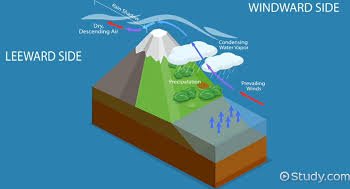
Mountains can force moist air upward. When air encounters a mountain range, it may be pushed toward higher elevations instead of continuing horizontally.
As the air rises, it expands and cools. Cooling can cause water vapor to condense, producing clouds and potentially precipitation on the side facing the incoming moist air. This process is called orographic lifting.
Why Is One Side of a Mountain Often Wetter?
When moist air rises along one side of a mountain, it can lose significant amounts of moisture through condensation and precipitation. By the time the air descends on the opposite side, it may contain much less water vapor.
The descending air warms as it moves into higher atmospheric pressure. This can produce drier conditions on the mountain’s sheltered side, creating what is known as a rain shadow. Some of the world’s driest regions occur in areas influenced by this effect.
How Do Weather Fronts Produce Rain?
Weather fronts form where different air masses meet. When warm, moist air is forced upward by denser surrounding air, it can cool and produce clouds and precipitation.
The type and intensity of rainfall depend on the structure and movement of the front. Some fronts can produce widespread, gentle precipitation, while others can generate narrow areas of heavier rain and thunderstorms.
How Do Thunderstorms Produce Heavy Rain?
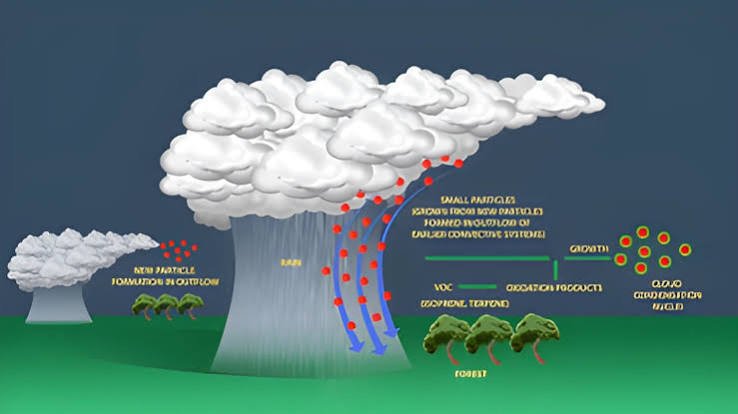
Thunderstorms are powered by strong upward and downward movements of air. Warm, moist air rises rapidly, carrying large quantities of water vapor into colder parts of the atmosphere.
As the moisture condenses and precipitation particles grow, the cloud can produce heavy rainfall. Powerful downdrafts can then transport cooled air downward, creating additional changes in wind and pressure. This dynamic structure allows thunderstorms to produce intense bursts of precipitation over relatively short periods.
What Happens When Rain Reaches the Ground?
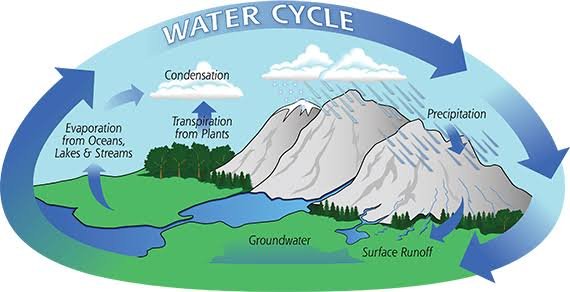
Once raindrops reach the Earth’s surface, they become part of the continuing water cycle. Some water flows across the ground into streams and rivers, while some infiltrates the soil.
A portion may eventually reach underground water systems, while another portion can return to the atmosphere through evaporation or plant transpiration. Some water may also be stored temporarily in lakes, glaciers, soil, or vegetation.
Does All Rainwater Reach Rivers and Oceans?
No. Rainwater can follow many different pathways after reaching the ground. Some infiltrates soil and becomes part of groundwater, while some is absorbed by plants and later released through transpiration.
Other water flows over the surface into drainage systems, streams, rivers, and eventually lakes or oceans. The exact pathway depends on soil type, vegetation, terrain, temperature, land use, and the intensity of rainfall.
Why Is Rain Important for Life?
Rain provides freshwater needed by ecosystems, agriculture, wildlife, and human communities. It replenishes rivers, lakes, wetlands, and groundwater supplies while supporting plant growth.
Rainfall also influences climate and natural ecosystems. Different species have adapted to different precipitation patterns, from extremely dry deserts to tropical environments where rain occurs frequently. The distribution of rainfall is therefore a major factor shaping life across the planet.
How Does Rain Return to the Atmosphere?
Rain does not permanently remove water from the atmosphere. After precipitation reaches Earth’s surface, solar energy drives evaporation from oceans, lakes, rivers, and soil.
Plants also release water vapor through tiny openings in their leaves in a process called transpiration. Together, evaporation and transpiration return moisture to the atmosphere, allowing the water cycle to begin another stage.
People Also Ask (PAA)
How does rain form step by step?
Rain begins when water evaporates from Earth’s surface and enters the atmosphere as water vapor. Moist air rises and cools, causing condensation and cloud formation. Tiny droplets or ice particles then grow until they become heavy enough to fall toward the ground as precipitation.
Why does water vapor turn into rain?
Water vapor turns into precipitation after cooling and condensing into cloud particles that grow sufficiently large. Gravity eventually pulls these larger particles downward when they can no longer remain suspended.
Does rain come directly from clouds?
Yes, rain develops from water droplets or ice particles within clouds. However, those particles may grow through different processes before becoming large enough to fall from the cloud.
Why does rain fall instead of staying in the cloud?
Very small cloud droplets can remain suspended because of air resistance and upward air currents. As precipitation particles grow, gravity becomes more influential, eventually causing them to fall.
Can it rain without clouds?
Under ordinary atmospheric conditions, precipitation requires a source such as a cloud or a nearby collection of atmospheric moisture. Rain reaching the ground generally originates from clouds, although the cloud itself may not always be obvious from the observer’s location.
Why does rain sometimes evaporate before reaching the ground?
If the air beneath a cloud is dry enough, falling water can evaporate into the atmosphere. When this happens completely before reaching the surface, the phenomenon is called virga.
Frequently Asked Questions (FAQ)
1. What is the first step in rain formation?
The process generally begins with evaporation. Heat from the Sun causes water molecules at Earth’s surface to enter the atmosphere as water vapor.
2. What causes water vapor to become clouds?
Rising moist air cools as it expands. When it reaches saturation, water vapor can condense around microscopic particles in the atmosphere, producing cloud droplets or ice crystals.
3. How do clouds turn into rain?
Cloud particles must grow large enough to overcome the forces keeping them suspended. They can grow through droplet collisions and merging or through processes involving ice crystals before eventually falling as precipitation.
4. What makes raindrops fall?
Gravity pulls growing water drops downward. When a particle becomes large enough, its downward movement can overcome the effects of air resistance and upward air currents.
5. Is rainwater originally from the ocean?
A large portion of atmospheric water ultimately comes from oceans because they cover such a large area and experience continuous evaporation. However, lakes, rivers, soil, plants, and other sources also contribute moisture.
6. Why is rain sometimes heavy?
Heavy rain can occur when a cloud contains abundant moisture and strong upward air movement. Thunderstorms are particularly capable of producing intense rainfall because they continuously transport moist air upward.
7. Can rain form when the sky looks clear?
Rain reaching the ground normally comes from clouds, although clouds may be distant, thin, or hidden from direct view. Precipitation can also evaporate before reaching the surface.
8. What happens to rain after it reaches Earth?
Rainwater can run across the surface, enter soil, replenish groundwater, be absorbed by plants, collect in bodies of water, or eventually return to the atmosphere through evaporation and transpiration.
Conclusion
Rain formation is a continuous journey that begins when water receives energy and evaporates from Earth’s surface. The resulting water vapor rises with moving air, cools as the air expands, and eventually condenses into microscopic droplets or ice crystals. Inside suitable clouds, these particles grow through collisions, condensation, and ice-related processes until gravity can pull them downward. The falling precipitation then passes through the atmosphere, sometimes changing shape or evaporating before reaching the ground.
Once rain reaches Earth’s surface, the process does not truly end. Water enters rivers, lakes, soil, groundwater, plants, and oceans before eventually returning to the atmosphere through evaporation and transpiration. This repeating circulation forms an essential part of the global water cycle and supports ecosystems, agriculture, freshwater supplies, and life itself. From an invisible molecule of water vapor to a falling raindrop, every stage demonstrates how atmospheric conditions work together to create one of Earth’s most important natural processes.